
What’s Happening in Medical Drones, Globally— And Where India Stands

A technical status report on medical drone logistics, clinical supply-chain integration and the transition from pilots to health-system infrastructure
Dr Ruchi Saxena
For nearly a decade, medical drone delivery was primarily a pilot-project category: technically attractive, highly visible and difficult to institutionalise. But in 2026, unmanned aircraft systems (UAS) are being incorporated into hospital logistics pathways, public-health supply systems, laboratory transport networks, regulated beyond-visual-line-of-sight (BVLOS) operations and increasingly, for direct-to-patient fulfillment. It has been now well established that drones can successfully and cost-effectively transport a blood sample, a vaccine or a prescription. The big question that now stems is whether a medical drone program can have the governance, quality, and capability necessary to become a routine national health systems infrastructure. This review maps the global medical drones industry: the projects, partnerships, funding, new entrants, evidence and regulation. It then assesses India’s position and the policy architecture required for scale.
Medical Drones Partnership Models
Scaled medical-drone services typically rely on a multi-party operating model rather than a bilateral vendor relationship. The core configuration includes:
- a UAS operator responsible for aircraft operations and maintenance;
- a healthcare purchaser or health-system partner responsible for selecting clinically meaningful use cases and paying for the service; and,
- a logistics or technology integrator responsible for airspace coordination, workflow integration, ground handling and chain-of-custody control.
Some recently partnerships that have been announced in the medical drones sector are:
· Zipline ↔ Advocate Health: Advocate Health announced plans for what it describes as the largest hospital-based drone-delivery network in the United States. The service is intended to support prescriptions, laboratory-related transfers and medical supplies across three markets, with more than 100,000 deliveries projected annually, provided they work full-scope and get all the necessary approvals.1
· Zipline ↔ Cleveland Clinic: Cleveland Clinic began a drone-enabled prescription-delivery service for eligible patients in eastern Cleveland suburbs, initially within a five-mile area around its Beachwood campus. The partnership represents an important shift from hospital-to-hospital logistics toward regulated direct-to-patient pharmaceutical fulfilment.2,3
· Matternet ↔ Apian ↔ NHS: Matternet and Apian have supported NHS-linked clinical logistics in London, including transport of laboratory samples, pharmaceuticals and urgent medical items between hospital sites. This model is relevant because the aircraft service is embedded in an institutional pathology and clinical-logistics workflow rather than positioned as a consumer-delivery trial.4,5
· Skyports ↔ NHS Partners ↔ Healthcare Logistics Providers: UK programmes have combined specialist UAS operations with NHS clinical users and logistics providers. Their significance lies in testing how specimen movement, blood-product transport and urgent supply pathways can be integrated with existing hospital courier systems rather than displacing them indiscriminately.6,7
· Skye Air Mobility ↔ Indian Healthcare and Pharmaceutical Partners: Indian operators are using partnerships with pharmaceutical, public-health and hospital stakeholders to test medicine, specimen and supply-chain use cases. These arrangements are still heterogeneous and require clearer independent outcome reporting before they can be treated as standing health-system services.8,9
· Zipline ↔ Governments and Public Purchasers in Africa: Rwanda and Ghana remain the clearest illustrations of health-system and government participation in drone logistics. Their relevance is not simply the scale of flights; it is the use of a hub-and-spoke model to support public-health supply availability for geographically dispersed facilities.10,11
Medical Drones Project Models
Africa
Rwanda is the most established example of national medical-drone logistics. Zipline’s operations have supported blood products, vaccines, medicines and urgent supplies for remote facilities within a public-health context. The relevance of the Rwanda model lies in its integration with national health-service needs and an enabling regulatory environment, not simply in the number of aircraft deployed.10,12
Ghana operates a multi-hub model serving a large network of facilities, with drone delivery designed to improve access to essential medical commodities in rural and remote areas.11 Evidence from the Ghana experience has been used internationally to examine stock-out reduction and emergency replenishment value.13 Nigeria represents a further expansion pathway, where planned hubs and state-level operations will need to demonstrate sustained demand, procurement viability and regulatory continuity to progress beyond early deployment.14
United Kingdom
The UK has developed a hospital-centred model, particularly for pathology and urgent clinical logistics. London’s NHS-linked corridors demonstrate the use of drones for movement of samples and essential medical items between hospital facilities. In a frequently cited Guy’s and St Thomas’ pathway, air transport markedly reduced travel time compared with road transport. However, the operational value depends on whether faster transport reliably improves laboratory turnaround, clinical decision-making or service resilience.5,15
In Scotland, Project CAELUS has examined inter-health-board logistics and remote-area connectivity. Skyports’ work with NHS Argyll and Bute provides operational experience in remote-island conditions, including long-distance BVLOS activity for pathology and COVID-19 test transport.6,16 Wales’ Project Dragon’s Heart is similarly focused on whether UAS can support blood-service and ambulance-related logistics in a clinically governed manner.17
United States
US activity is developing along two tracks. The first is institutional medical logistics: Project MARS at Keller Army Community Hospital has progressed from research activity toward autonomous medical resupply operations.18 The second is patient-facing healthcare delivery, represented by Advocate Health’s planned network and Cleveland Clinic’s prescription-delivery programme.1–3 These programmes are important because US scale will depend on the interaction between clinical demand, Part 135 operations, type certification, local permissions and the future direction of FAA BVLOS rulemaking.
Ireland
Rotunda Hospital and Manna Air Delivery tested a medical logistics scenario involving blood and pathology samples between Rotunda Hospital and Connolly Hospital.19 Ireland’s relevance is its attempt to apply a domestic drone-delivery platform to hospital-linked clinical transport, while retaining patient safety, chain-of-custody and laboratory workflow requirements.
Middle East
In Dubai, Fakeeh University Hospital piloted medication-to-home delivery under the Dubai Programme to Enable Drone Transportation.20 Saudi Arabia tested drone-enabled medical supply corridors during the Hajj period, where time-sensitive distribution and high service demand create a distinctive operational context.21 Such use cases need to be evaluated against road congestion, demand volatility, payload requirements, heat exposure, medicines governance, and emergency-response protocols, not only flight duration.
China
China is pursuing urban and regional drone-logistics models at significant scale. Reports describe licensed medical routes operated by Antwork, scheduled medical services in Shanghai and diagnostic-sample transport from difficult-to-access areas in Hainan.22–24 These networks are integrated with laboratory information systems, hospital supply-chain governance and formal aviation oversight.
Brazil / Latin America
Brazil medical drone operations are significant for their regulatory trajectory. Speedbird Aero has secured authorisation for delivery operations over more densely populated areas under a risk-based approach, creating a potentially more scalable alternative to route-by-route approvals.25
Medical Drones Funding Models
Funding matters because healthcare drone logistics have long development cycles: certification, aircraft engineering, safety cases, airspace integration, site infrastructure, workforce training and hospital integration – all require capital before recurrent service revenues are established. However, venture funding is not equivalent to sustainable health-system deployment. The field should distinguish five financing mechanisms:
- venture capital;
- strategic corporate investment;
- public infrastructure finance;
- health-system procurement; and
- blended donor or development finance.
Zipline, Matternet, Manna and other established operators have attracted significant external capital. Funding figures should be cited only from company announcements, financial filings or high-quality financial reporting, because secondary summaries frequently vary in round size, valuation and transaction date.
Public-health deployment in Africa is structurally different from urban commercial delivery: government participation, public procurement and development-finance support may be more consequential than conventional venture capital.
For India, the most important investment question is whether capital can bridge the period between pilot activity and recurring service contracts. A health-logistics operator cannot rely indefinitely on demonstration funding, retail cross-subsidy or one-off state trials.
New Ventures worth Watching
The next phase of the field is likely to be defined by specialized operators whose proposition is beyond ‘drone delivery’, rather a specific clinical logistics capability that includes sample movement, emergency blood logistics, pharmacy delivery, rural-to-reference laboratory connectivity or temperature-sensitive supply transport. Some new names entering the medical drones are:
· Airbound (India): a newer entrant working on the unit-economics challenge of diagnostic logistics, including a reported collaboration with Narayana Health.26
· Avion (United States): an early-stage operator focused on autonomous movement of clinical samples and medical supplies between remote care settings and urban infrastructure.
· Jedsy (Switzerland/Germany): a specialist medical-delivery company oriented toward laboratory transport, including deployment discussions with hospital partners.
· Speedbird Aero: while not a new company, it is a comparatively new entrant in many international markets. Its experience in Brazil is increasingly being used to support international regulatory and commercial expansion.25
Research and Evidence in Medical Drones
The most decision-relevant medical drones research studies quantify changes that a hospital board, state health department or a finance ministry can act upon. They measure and analyze diagnostic turnaround time, stock-out duration, product expiry, emergency replenishment time, avoided travel, cost per clinically meaningful delivery, cold-chain integrity, patient expenditure and equity of access.
Some key studies that have been recently published are:
· ICMR’s i-DRONE work in Telangana assessed drone-based transport of TB sputum samples under the National TB Elimination Programme published a study that reported a median diagnostic turnaround-time reduction from 15 days to 5 days among 840 participants, alongside major reduction in patient out-of-pocket expenditure. This is among the stronger recent examples of a medical-drone evaluation linked to a defined disease programme and measurable pathway outcome.27,28
· Evidence from Rwanda has associated drone-supported supply systems with lower blood-product wastage, demonstrating that the value proposition may include inventory optimisation and reduction in expiry besides faster emergency transport.13
· Ghana research paper has explored whether facilities served by drone delivery experience fewer stock-out days. The significance of this work is that it links aviation operations to supply-chain reliability, a more meaningful health-system metric than mission counts.13
· United Kingdom’s E-Drone research programme has investigated and compared the value of a medical drone logistics to the conventional transport. This is essential because clinical value depends on route characteristics, volume, time sensitivity, geography and existing courier performance.29
· The DAEDALUS proof-of-concept programme is examining delivery of automated external defibrillators to bystanders during cardiac arrest. Its evidence requirement is especially stringent: time-to-device, dispatch coordination, public acceptability, safety and integration with ambulance-service response must all be demonstrated.30
Regulations and Policy Frameworks
Medical logistics at scale requires an aviation framework capable of authorising routine BVLOS operations while protecting people, property, controlled airspace and critical infrastructure. The relevant requirements include aircraft airworthiness and reliability, command-and-control resilience, detect-and-avoid capability, operational risk assessment, personnel competency, communications security, contingency procedures, geofencing, airspace coordination and incident reporting.
· United States: FAA Part 108 should be described as a proposed BVLOS framework, not as a final or operative rule. In 2026, medical-drone operators continued to rely on existing certification and authorisation pathways, including Part 135-related operations and individual approvals.31,32
· United Kingdom: UK policy is moving toward a more enabling BVLOS environment, initially in atypical airspace such as remote locations and open water. The future scale of NHS applications will depend on the pace of implementation, UTM capability and local public acceptance.33
· Brazil: Speedbird’s authorisation for operations over locations with population density up to 5,000 people per km² illustrates a more scalable, risk-based approach to urban BVLOS deployment.25
· Rwanda: performance-based regulation enabled the development of a national drone-health logistics model early in the sector’s evolution. Rwanda remains a reference case for regulators seeking to align safety oversight with public-health logistics need.12
· India: the regulatory environment became more enabling under the Drone Rules 2021 and DigitalSky framework, but routine health logistics still requires a clear pathway from limited corridor permissions to risk-based, interoperable BVLOS operations supported by UTM infrastructure and clinical governance.34
The India Story
Where the Regulation Stands
India has moved substantially beyond the earlier restrictive UAS environment. The Drone Rules 2021 simplified permissions and established a more enabling regulatory framework. Yet a liberal regulatory posture is not the same as operational readiness for health-system logistics. Routine medical drone networks require a dependable authorisation pathway, standardised clinical cargo requirements, validated packaging procedures, digital traceability, geographical risk management, site approvals and contingency protocols.34
The key policy gap is therefore not whether India permits drones in principle. It is whether a public-health purchaser can confidently procure a standing BVLOS logistics service that operates reliably across defined clinical corridors and integrates with national and state health systems.
The Evidence Base
India’s strongest asset is its public-sector evidence base. The i-DRONE initiative has tested medical logistics across multiple terrains and use cases. Its Telangana TB-sputum work demonstrates a clinically relevant outcome: faster diagnostic turnaround within an established national disease-control programme.27,28 The wider programme has also generated learning on vaccines, samples and essential medical supplies across geographically diverse states.35
The next step is evidence synthesis and health technology assessment. India needs a nationally comparable dataset showing route characteristics, service reliability, payload integrity, cost per delivery, avoided travel, impact on laboratory turnaround, patient cost, stock-out avoidance and equity outcomes. Without this, promising pilots will remain difficult to procure at scale.
The Operator Landscape
India has a growing domestic operator ecosystem. Skye Air Mobility, TechEagle, Redwing Labs, Airbound and other companies represent different technical and commercial approaches to healthcare and logistics operations.8,9,26 The strategic advantage of India’s domestic ecosystem is competitive pricing, local maintenance capacity, operator training, manufacturing learning, service resilience and the potential to develop Indian standards for clinical drone logistics.
How India Compares
India is not equivalent to Rwanda or Ghana in terms of a single government-contracted, always-on national medical-drone network. Nor does it yet have the maturity of a broadly scalable urban BVLOS approval model such as that emerging in Brazil. What India has is a broad portfolio of government-supported pilots, highly varied terrain, substantial public-health logistics demand and a domestic operator base capable of supporting experimentation and eventual scale.
India’s comparative advantage is that it has assembled more of the jigsaw pieces in the ecosystem puzzle than most countries: operational experience, public-sector interest, clinical use cases, industrial capability and an unusually wide range of challenging service environments.
Why India Is Still the Largest Potential Market for Medical Drones
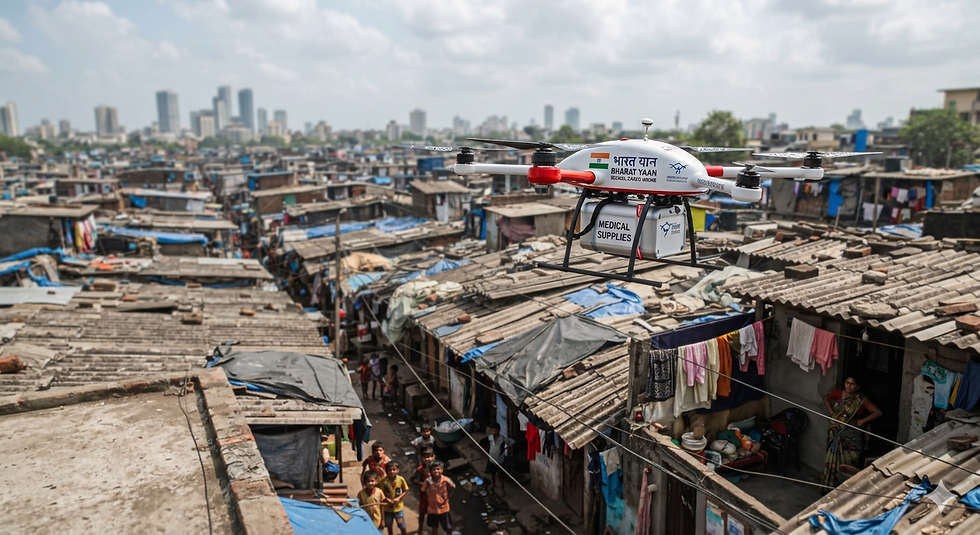
A diverse and rooted health-service structure
India’s network of sub-centres, primary health centres and community health centres is designed to extend care to rural and underserved populations. Persistent infrastructure, workforce and referral constraints can mean that logistics delays would amplify clinical disadvantage. In this context, drone-enabled movement of specimens, blood products, vaccines and urgent medicines could function as a last-mile and middle-mile resilience layer. However, medical drones must be integrated with existing care pathways rather than deployed as an isolated technology.36,37
Terrain diversity no other single market has to solve for
India must design for Himalayan and north-eastern mountain corridors, flood-prone and monsoon-affected geographies, islands, forested areas, dense peri-urban zones and high-volume metropolitan hospital networks. The operational protocols required for cold-chain maintenance, weather management, site safety and contingency planning in these environments would have substantial global relevance.
Population and disease burden at a scale that changes the unit economics
India’s TB burden, maternal and child health requirements, need for timely diagnostics and continuing household health expenditure make transport delays materially significant. The right unit-economics question is not merely cost per flight. It is the incremental cost per avoided diagnostic delay, avoided patient journey, avoided stock-out, preserved blood unit or timely treatment initiation.27,36
Manufacturing capability that is being actively built, not imported
The production-linked incentive framework and broader domestic drone-manufacturing agenda can support health logistics by creating local capability in aircraft manufacture, components, maintenance, payload systems, thermal packaging, communications and software.37–39 However, industrial policy should be linked to quality and clinical-safety standards, rather than treated as a substitute for them.
Ease of doing business, specifically for this sector
India’s regulatory reforms lowered barriers to UAS operations compared with the preceding regime.34 The next phase requires regulatory certainty for clinically governed BVLOS services, including a practical UTM backbone, standardised safety cases and interoperable operating procedures across states.
Investment appetite that is already validated
Healthcare drone logistics has attracted investor interest because it sits at the intersection of health access, diagnostics, last-mile logistics, aviation technology and domestic manufacturing. Yet investment appetite alone will not create a durable service market. That requires repeat demand from hospitals, laboratories, state health systems, pharmaceutical supply chains and public-health programmes.40
What is actually missing in scaling Medical Drones in India
India has evidence, operators, diverse terrain and industrial momentum. The missing element is orchestration: government-led infrastructure planning, outcome-based public procurement, operating UTM capability, standardised clinical governance and a ministry-level decision to treat drone corridors as health logistics infrastructure rather than a series of time-limited pilots.
The Bottom Line
Medical drones are moving from novelty to infrastructure working towards credibility and scalability of programs, not just drone sales or flight demonstrations. They are solving specific logistics failures: delayed diagnosis, inaccessible blood products, recurrent stock-outs, unreliable road transport, costly patient travel and emergency replenishment.
The global field is now producing a shared implementation playbook. Rwanda and Ghana demonstrate public-health network deployment. London demonstrates integration into hospital pathology logistics. US health-system partnerships demonstrate movement toward patient-facing fulfilment. Brazil demonstrates the importance of a scalable risk-based regulatory pathway. India contributes a growing evidence base and unusually diverse operating conditions.
India’s next opportunity is to convert this assembled capability into a nationally governed, clinically safe and outcome-based medical logistics system. The objectives of the next phase of medical drones ecosystem development should be a more resilient health system, the one in which distance, terrain and transport delay no longer determine whether a patient receives a diagnosis, a blood product, a vaccine or an essential medicine in time.
Dr Ruchi Saxena is a global consultant for adoption of innovations like Drones, AI and Robotics for Health Systems, and Founder-Director of Caerobotics.
References
1. Advocate Health. Advocate Health to launch nation’s largest hospital drone delivery network [Internet]. 2026 Mar 26 [cited 2026 Aug 15]. Available from: https://www.advocatehealth.org/news/advocate-health-to-launch-nations-largest-hospital-drone-delivery-network
2. Cleveland Clinic. Cleveland Clinic launches drone delivery program for prescription medications [Internet]. 2026 Aug 3 [cited 2026 Aug 15]. Available from: https://newsroom.clevelandclinic.org/2026/08/03/cleveland-clinic-launches-drone-delivery-program-for-prescription-medications
3. Cleveland Clinic. Pharmacy drone delivery: frequently asked questions [Internet]. 2026 [cited 2026 Aug 15]. Available from: https://my.clevelandclinic.org/-/scassets/files/org/pharmacy/drone-delivery-faq.pdf?la=en
4. Matternet Inc. Matternet partnerships and milestones [Internet]. 2026 [cited 2026 Aug 15]. Available from: https://www.matternet.com/milestones
5. Matternet Inc. Current report: commercial healthcare logistics operations [Internet]. 2026 May 29 [cited 2026 Aug 15]. Available from: https://investor.matternet.com/sec-filings/all-sec-filings/content/0001213900-26-062961/ea0292214-8k_matternet.htm
6. Skyports Drone Services. Medical drone deliveries with Skyports: NHS Argyll & Bute [Internet]. 2026 Jan 24 [cited 2026 Aug 15]. Available from: https://skyportsdroneservices.com/nhs-argyll-bute/
7. EMED Group. EMED Group and Skyports Drone Services trial medical courier services by drone [Internet]. 2024 May 24 [cited 2026 Aug 15]. Available from: https://www.emedgroup.co.uk/emed-group-skyports-drone-services/
8. ITLN. How drones in India are revolutionising healthcare logistics [Internet]. 2024 Sep 21 [cited 2026 Aug 15]. Available from: https://www.itln.in/cargo-drones/how-drones-in-india-are-revolutionising-healthcare-logistics-1353250
9. Electronics For You. Drone startups target healthcare logistics amid growing demand [Internet]. 2025 Mar 4 [cited 2026 Aug 15]. Available from: https://www.electronicsforyou.biz/industry-buzz/drone-startups-target-healthcare-logistics-amid-growing-demand/
10. TechAfrica News. Rwanda becomes Africa’s first country with nationwide Zipline health drone delivery [Internet]. 2026 Feb 6 [cited 2026 Aug 15]. Available from: https://techafricanews.com/2026/02/06/zipline-expands-in-rwanda-bringing-urban-drone-deliveries-and-ai-robotics-hub-to-africa/
11. IEEE Spectrum. Zipline expands medical drone-delivery service to Ghana [Internet]. [cited 2026 Aug 15]. Available from: https://spectrum.ieee.org/amp/zipline-expands-medical-drone-delivery-service-to-ghana-2650278441
12. Journal of Pharmaceutical Policy and Practice. The evolution of medication delivery via drones: revolutionizing healthcare logistics. 2025;18(1). Available from: https://www.tandfonline.com/doi/full/10.1080/20523211.2025.2519137
13. Healthcare logistics evidence review, Rwanda and Ghana [Internet]. 2026 [cited 2026 Aug 15]. Available from: https://pmc.ncbi.nlm.nih.gov/articles/PMC12914684/
14. DroneXL. Zipline bets Nigeria becomes its biggest African market with 12 new drone hubs by 2028 [Internet]. 2026 Jun 1 [cited 2026 Aug 15]. Available from: https://dronexl.co/2026/06/01/zipline-nigeria-expansion-12-hubs-2028/
15. Healthcare in Europe. Drone delivery of blood samples debuts in London [Internet]. [cited 2026 Aug 15]. Available from: https://healthcare-in-europe.com/en/news/drone-delivery-blood-samples-london.html
16. Skyports Drone Services. Press release archives [Internet]. [cited 2026 Aug 15]. Available from: https://skyportsdroneservices.com/category/press-release/
17. Skyports Drone Services. Project Dragon’s Heart launches, bringing NHS Wales closer to drone deliveries [Internet]. 2025 Sep 29 [cited 2026 Aug 15]. Available from: https://skyportsdroneservices.com/2025/09/project-dragons-heart-launches-bringing-nhs-wales-closer-to-drone-deliveries/
18. AirMed&Rescue. Army hospital receives FAA approval for its Project MARS drone program [Internet]. 2026 Feb 12 [cited 2026 Aug 15]. Available from: https://www.airmedandrescue.com/latest/news/army-hospital-receives-faa-approval-its-project-mars-drone-program
19. DroneLife. Dublin hospitals test high-speed drone delivery with Manna [Internet]. 2026 Mar 13 [cited 2026 Aug 15]. Available from: https://dronelife.com/2026/03/13/dublin-hospitals-test-high-speed-drone-delivery-with-manna/
20. Dubai Silicon Oasis. Fakeeh University Hospital pilots MENA’s first medical drone delivery in Dubai Silicon Oasis [Internet]. [cited 2026 Aug 15]. Available from: https://www.dso.ae/w/fakeeh-university-hospital-pilots-mena-s-first-medical-drone-delivery-in-dubai-silicon-oasis
21. Arab News. Drones delivering Hajj medicine years in the making, health minister tells Arab News [Internet]. 2025 Jun 3 [cited 2026 Aug 15]. Available from: https://www.arabnews.com/node/2603143/saudi-arabia
22. Drone Intelligence. Drone delivery operators 2026: medical VTOL to middle-mile [Internet]. [cited 2026 Aug 15]. Available from: https://droneintelligence.ai/drone-delivery-operators
23. Meituan and Shanghai medical drone route reports [Internet]. 2025–2026 [cited 2026 Aug 15].
24. People’s Daily Online. Drones transport medical samples from mountainous regions to hospitals in Hainan, improving local health care [Internet]. 2026 Apr 22 [cited 2026 Aug 15]. Available from: http://en.people.cn/n3/2026/0422/c90000-20449220.html
25. UAS Vision. Speedbird gains Brazil approval for urban BVLOS drone flights [Internet]. 2026 Mar 27 [cited 2026 Aug 15]. Available from: https://www.uasvision.com/2026/03/27/speedbird-gains-brazil-approval-for-urban-bvlos-drone-flights/
26. The Drone Girl. Could this Indian startup finally make drone delivery economics work? [Internet]. 2025 Oct 14 [cited 2026 Aug 15]. Available from: https://www.thedronegirl.com/2025/10/14/airbound/
27. Indian Council of Medical Research. Drone-based sputum transport for TB diagnosis in remote communities. 2026. Available from: https://pmc.ncbi.nlm.nih.gov/articles/PMC12991481/
28. Press Information Bureau, Government of India. ICMR study finds drone-enabled TB sample transport can improve diagnosis access [Internet]. 2025 Nov 20 [cited 2026 Aug 15]. Available from: https://www.pib.gov.in/PressReleasePage.aspx?PRID=2285227®=48&lang=1&noshow=1
29. University of Southampton, E-Drone Project. Drone medical use case v2: research summary [Internet]. 2023 May [cited 2026 Aug 15]. Available from: https://generic.wordpress.soton.ac.uk/edrone/wp-content/uploads/sites/516/2024/05/Drone-Medical-Use-Case-v2.pdf
30. ClinicalTrials.gov. Drone delivery of automated external defibrillators to lay users (DAEDALUS): a proof of concept study [Internet]. [cited 2026 Aug 15]. Available from: https://clinicaltrials.gov/study/NCT07430813
31. Airdata UAV. FAA Part 108 explained: everything drone operators need to know in 2026 [Internet]. [cited 2026 Aug 15]. Available from: https://airdata.com/blog/2026/part-108
32. Drone Authority. Part 108 drone rules explained: current BVLOS status [Internet]. 2026 Jun 13 [cited 2026 Aug 15]. Available from: https://droneauthority.org/laws/part-108
33. Digital Health. Drones could be used for NHS deliveries under new UK regulations [Internet]. 2025 Apr 25 [cited 2026 Aug 15]. Available from: https://www.digitalhealth.net/2025/04/drones-could-be-used-for-nhs-deliveries-under-new-uk-regulations/
34. Government of India. Drone Rules, 2021 and DigitalSky framework [Internet]. [cited 2026 Aug 15].
35. ICMR i-DRONE. India’s drone-based medical delivery initiative [Internet]. [cited 2026 Aug 15]. Available from: https://idrone.icmr.org.in/
36. PMF IAS. India’s primary healthcare sector: status and key concerns [Internet]. 2025 Apr 22 [cited 2026 Aug 15]. Available from: https://www.pmfias.com/primary-healthcare-sector/
37. Malhotra R. India’s healthcare paradox: would the domestic doctor shortage result in failure of journey towards universal health coverage? Int J Community Med Public Health. 2026;13(5):2550-61. Available from: https://www.ijcmph.com/index.php/ijcmph/article/view/15551
38. Kodainya. India’s drone manufacturing ecosystem: 23-firm PLI cohort [Internet]. 2026 May 20 [cited 2026 Aug 15]. Available from: https://www.kodainya.com/blogs/indias-drone-manufacturing-ecosystem
39. Whalesbook. India finalizes drone PLI 2.0 for local manufacturing boost [Internet]. 2026 Jan 30 [cited 2026 Aug 15]. Available from: https://www.whalesbook.com/news/English/industrial-goodsservices/India-Finalizes-Drone-PLI-20-for-Local-Manufacturing-Boost/697ce3265fc43f26c54bdcfe
40. Outlook Business. Budget 2026 may bring ₹10,000-Cr boost for drone manufacturing [Internet]. 2025 Dec 22 [cited 2026 Aug 15]. Available from: https://www.outlookbusiness.com/budget/budget-2026-may-bring-10000-cr-boost-for-drone-manufacturing


Comments